Why business owners look at cash value
A business owner's money usually sits in three places: an operating account, a retirement plan with contribution caps and market risk, and personal savings. Cash value life insurance adds a fourth: an asset that grows on a contractual schedule, is not exposed to market losses, and can be borrowed against without a bank's approval or a credit application.
That matters most for owners whose income is lumpy. A strong quarter can leave surplus cash that will be taxed if it stays in the business, and the owner may already be maxing out retirement plan contributions. A policy gives that surplus a place to go that builds an accessible balance over time.
How the policy becomes a bank
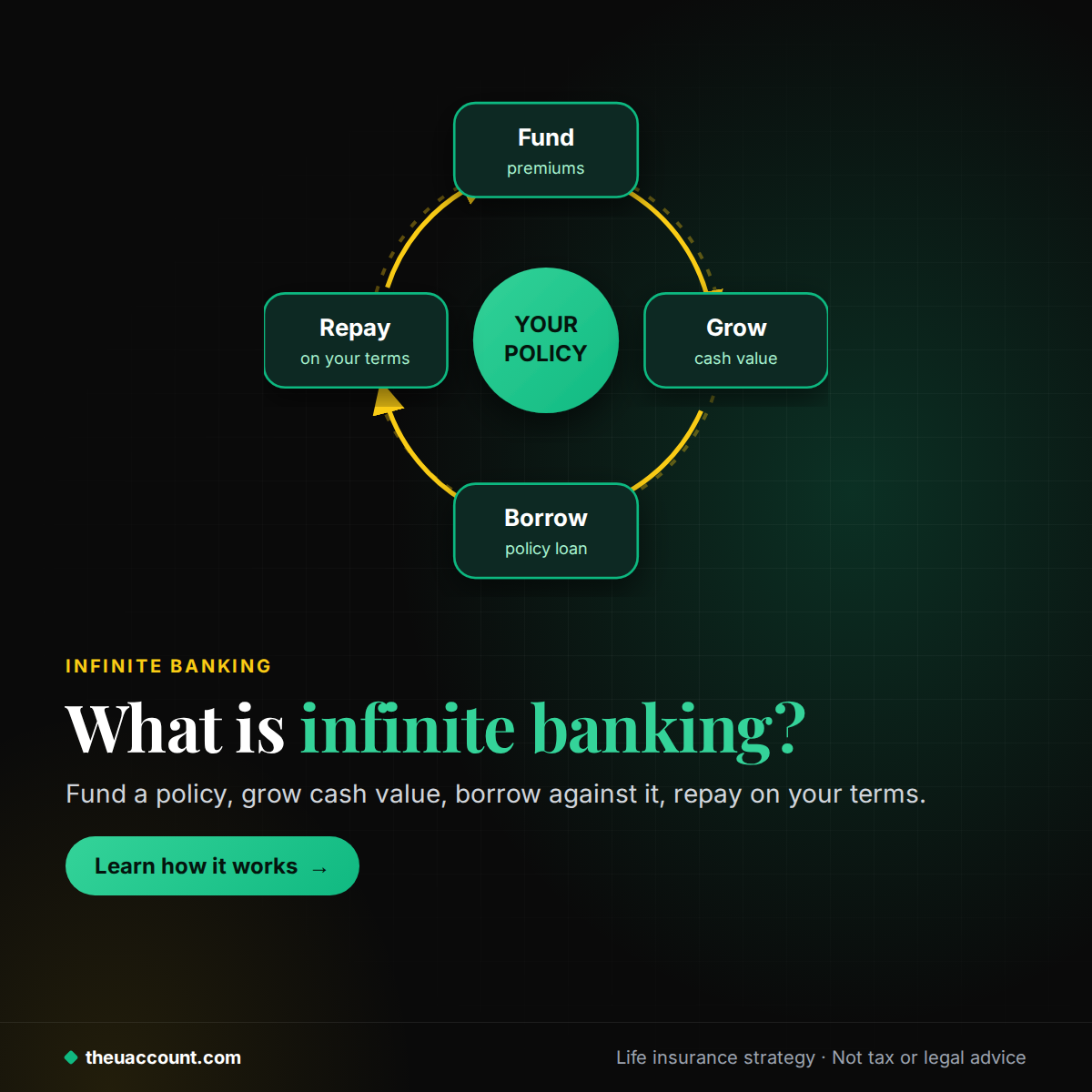
This is the mechanic behind the infinite banking concept, and it is worth understanding before you evaluate any illustration.
- Fund the policy. You pay premiums with after-tax business or personal dollars. The policy is designed to push as much premium as possible into cash value while staying under the Modified Endowment Contract limit.
- The cash value grows. Growth is guaranteed by contract, with potential dividends from a mutual insurer. It grows tax-deferred inside the policy.
- Borrow against it. When you need capital, you take a policy loan using the cash value as collateral. The insurer does not underwrite your business or check your credit.
- The base keeps compounding. Because the loan is secured by the policy rather than withdrawn from it, the full cash value generally continues to earn. The loan accrues interest, and repayment restores your available capacity.
- Repeat. Repaid loans free up room to borrow again, which is why practitioners describe the policy as a personal banking system rather than an investment.
The honest version: you still pay interest on the loan. The benefit is who you pay it to, that it is not a taxable event while the policy is in force, and that the cash value keeps growing. If a policy is underfunded or loans are never repaid, the math breaks down.
Cash on the balance sheet: bank account vs. policy
Every dollar of surplus cash a business holds is already on the balance sheet. The question is what it does while it sits there. In a business savings account it earns a small taxable rate, and the moment you spend it on equipment or inventory it leaves the balance sheet and has to be rebuilt from scratch.
Funded into a whole life policy instead, the same dollars become a contractual asset that grows on schedule. When the business needs that $150,000 for equipment, it borrows against the policy: the cash value does not get spent down, it stays on the balance sheet and keeps compounding, with the loan carried as a liability you repay on your own terms.
Illustrative only: $30,000 per year for 20 years, and a $150,000 equipment purchase in year 10. Policy figures are a guaranteed-cash-value shape, not a quote or a projection of performance.
Read it honestly: the policy line starts below the bank line, because early-year cash value is lower than premiums paid. That gap is the cost of the structure. What changes the outcome is the shape of the line after it crosses, and the fact that a policy loan does not remove the asset from the balance sheet the way a cash purchase does. Replace the numbers with your own cash flow and the crossover moves; the direction does not.
What owners use it for
Working capital
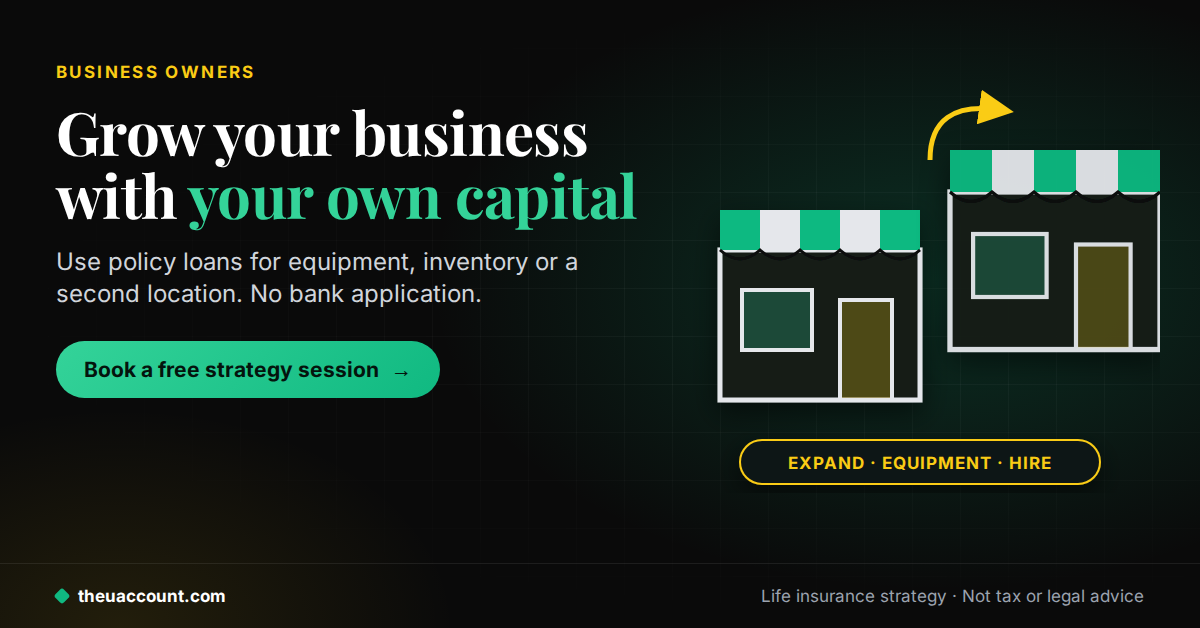
Inventory, equipment, or a payroll gap covered without a bank application or a lien on receivables.
Opportunity capital
Ready money for a distressed acquisition, a lease buyout, or a discount from a supplier that requires fast cash.
Key person coverage
Protection against the financial loss of losing a partner or an indispensable employee.
Buy-sell funding
Cash to buy out a partner's interest at death, disability, or retirement, matching the terms in your agreement.
Executive benefits
A selective benefit for key employees, often structured as a bonus plan or a supplemental retirement arrangement.
Tax diversification
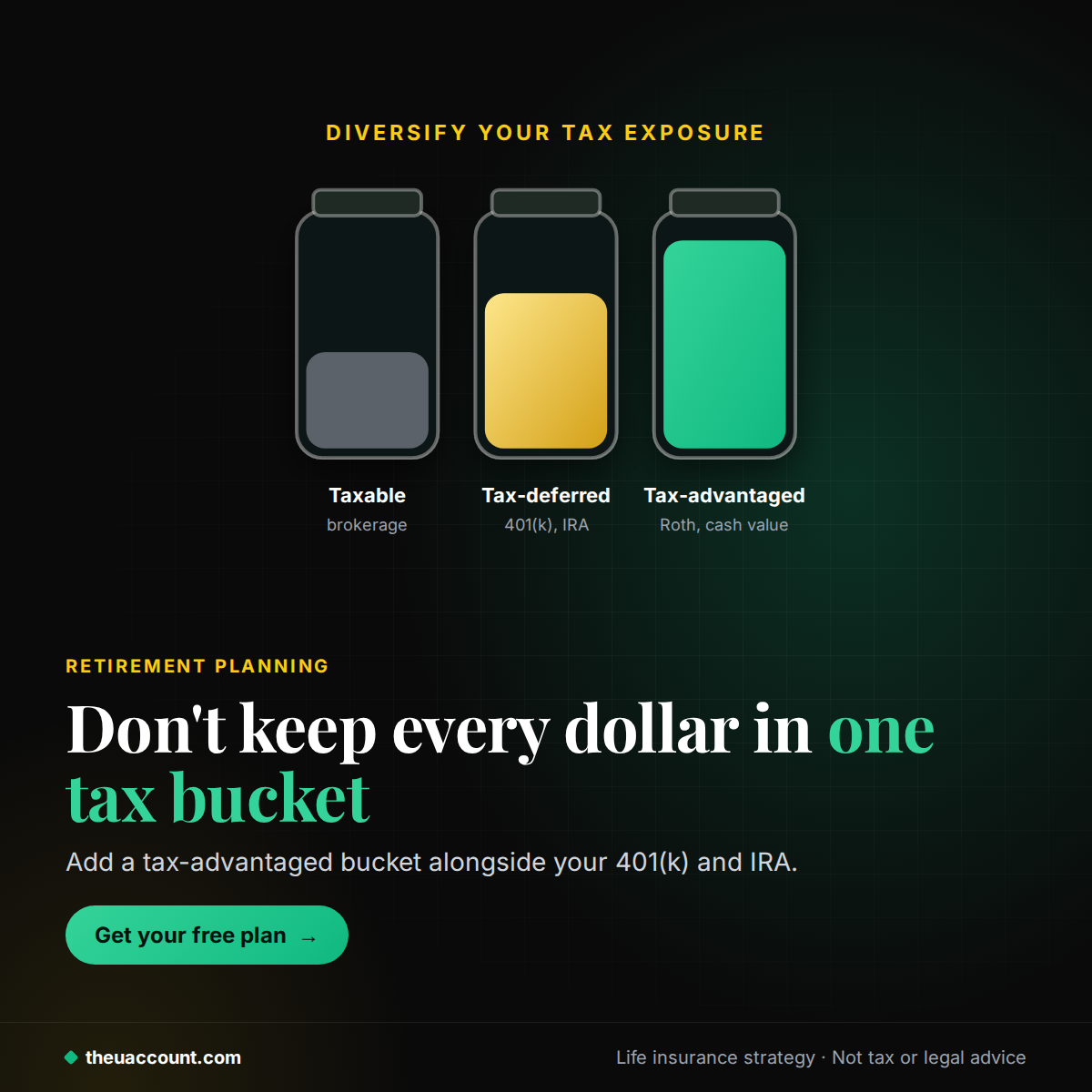
A bucket that behaves differently from pre-tax retirement accounts, useful when you want control over future tax brackets.
Owners also use it as a personal balance sheet reserve: capital that is contractually theirs, not a lender's, and that does not move with the market during a downturn.
Funding it from business cash flow
The most common mistake is treating a policy like a purchase instead of a commitment. A design that requires more premium than your worst quarter can support will be surrendered in year three, and the early-year cash value will be lower than what you paid in.
A workable sequence: keep three to six months of operating expenses in cash, fund your retirement plan to the level you actually intend to sustain, then commit a premium you could pay even in a slow year. Increase it later through paid-up additions riders rather than starting at a number you cannot defend.
Tax and structure rules that matter
Ownership decides the tax treatment
If the business owns the policy and is also the beneficiary, premiums are generally not deductible and the death benefit is generally received income-tax-free. If the business pays premiums on a policy the employee owns, it may be treated as compensation with its own deduction and reporting rules. There is no universal answer, and the choice should be made with your CPA and attorney before the application is submitted.
Avoid the MEC line
Funding a policy too quickly can make it a Modified Endowment Contract. A MEC still grows tax-deferred, but loans and withdrawals are taxed differently and can carry a penalty before age 59½. For a business owner with lumpy income, this is an easy line to cross accidentally, which is why funding is spread across years by design.
Loans are not free money
A policy loan is generally not treated as taxable income while the policy remains in force and is not a MEC. If the policy lapses or is surrendered with a loan outstanding, the gain can become taxable. That single risk is what separates a well-managed strategy from a cautionary tale.
Risks to respect
- Illiquidity in the early years. Cash value is below premiums paid for the first several years. Never fund a policy with money you may need for operations.
- Premium commitment. Fixed premiums for the life of the policy. Choose a number your worst month can cover.
- Loan discipline. Borrowing and repaying on a schedule is what keeps the system intact. Unrepaid loans erode the death benefit and can force a lapse.
- Dividends are not guaranteed. Growth projections beyond the guaranteed column are illustrations, not promises.
- Underwriting. Coverage depends on your health and financial underwriting. A business owner with health issues may face higher costs or a decline.
- Design and advice quality. A policy that is not built for cash value, or is sold without showing the guaranteed numbers, usually disappoints. That is the real story behind most negative reviews.
If you are still weighing product types, the IUL vs whole life comparison breaks down how each credits growth, and whole life for kids covers the family version of the same design. For the numbers on your own situation, run a quote estimate first.
Frequently asked questions
Can a business own a whole life policy on the owner?
Yes. Coverage can be owned by the business, by a trust, or personally, and each structure has different tax and control consequences. Business-owned coverage is often used for key person protection, buy-sell funding, or executive benefit plans. Which structure fits depends on your entity type and exit plan, so the ownership decision should be made with a CPA and an attorney before the application is signed.
Are whole life premiums tax deductible for a business?
Generally no, when the business is both the owner and the beneficiary, because the death benefit would be received income-tax-free. Premiums may be deductible in specific arrangements, such as certain executive bonus plans or group carve-out designs, where the premium is treated as compensation to the employee. Those arrangements have their own rules and reporting, so they need professional review.
How do business owners use cash value as a bank?
The owner funds a properly designed policy with business cash flow, then borrows against the cash value when capital is needed, using the policy as collateral instead of applying for a bank loan. The loan is generally not treated as taxable income while the policy stays in force and is not a Modified Endowment Contract. The business still pays interest on the loan, but the cash value continues to grow as though the money were still there.
How much cash value can a business access?
Typically a percentage of the available cash value, set by the insurer, commonly in the range of 90% of the cash surrender value depending on the policy year and the carrier. Accessing too much, or leaving loans outstanding too long, risks the policy lapsing, which can create a taxable event.
Is this better than keeping cash in the business account?
It is different. A business bank account is liquid and pays modest interest that is taxable. Policy cash value grows tax-deferred and can be borrowed against, but it is illiquid in the early years and carries surrender costs. Most owners keep an operating reserve in cash and add a policy for the surplus they do not need to touch.
Can cash value cover a buy-sell agreement?
Yes, and it is one of the most common business uses. A policy on each partner, owned through a cross-purchase or entity arrangement, provides the funding to buy out a partner's interest at death or disability. The structure must match your buy-sell agreement exactly, which is why the attorney, the CPA, and the insurance design have to be coordinated.
See what your surplus cash could be doing
Bring your business cash flow and your goals. We'll show an illustrated design and the guaranteed numbers behind it.
This page is for educational purposes only and is not tax, legal, or investment advice. Life insurance guarantees are subject to the claims-paying ability of the issuing insurer. Dividends and index credits are not guaranteed. Policy loans and withdrawals reduce cash value and death benefit and may be taxable if the policy lapses or is a Modified Endowment Contract. Consult a qualified tax professional about your situation.